Private Money Loans
Asset-based financing secured by the property itself, built for investors who need to move faster than conventional underwriting allows.
Learn more about Private Money Loans
Loan Services
Purchase and renovation capital in a single facility, with construction funds released in stages as the work is completed.
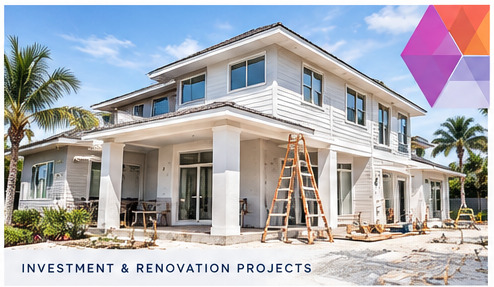
Fix-and-flip financing funds two things at once: the acquisition of a property that needs work, and the work itself. The purchase portion funds at closing. The renovation portion is held back and released in draws as the work is finished and verified, so the lender is advancing against value that actually exists on site.
Underwriting looks forward as well as back. The lender assesses the property as it is today, the scope and budget to improve it, and the supportable after-repair value once the work is done. The gap between what the project costs all-in and what it is worth at completion is the margin that protects both of you — which is why a realistic budget matters more than an optimistic one.
Potential uses
Before you borrow
Scopes are reviewed closely, and a budget that is obviously light will slow or sink a file. More importantly, an underfunded renovation is the most common way these projects fail. Price the work properly, include a contingency, and assume something behind the walls will surprise you.
Renovation funds arrive after work is done and inspected, not before. That means you need working capital to start each stage and to carry the gap until the draw clears. Ask how draws are requested, how long inspections take, and whether there is a fee per draw, and build that rhythm into your schedule.
The resale figure that makes a deal work has to be defensible with comparable sales, not aspiration. An independent valuation will test it. If the valuation comes in below your projection, the loan is sized to the valuation — so stress-test your numbers before you are committed to a purchase price.
Interest, taxes, insurance, utilities and security accrue through the renovation and through the marketing and closing period that follows. Projects routinely take longer to sell than to build. Budget the carry for the whole cycle with a margin.
Permitting delays and contractor availability are the two factors most likely to extend a project, and neither is under the lender's control. Line up your contractor and understand the local permitting process before you commit to a closing date and a loan term.
Profits on a property bought to resell are generally treated differently from long-term investment gains, and frequent flipping can affect how the activity is characterised. Speak to your own tax adviser early — this is not advice we can give you.
The process
Address, purchase price, your renovation scope and budget, your projected resale value and the evidence behind it, and your timeline.
We assess the purchase, the budget and the projected value together, and come back with what the structure can realistically support.
Purchase contract, a line-item scope and budget, contractor details, entity documents, and evidence of the cash you are bringing and the reserves behind it.
An independent valuation establishes both the current value and the supportable after-repair value, which together size the loan.
Written terms set out the purchase advance, the renovation holdback, the draw schedule and all costs. Closing funds the purchase portion.
As stages complete, you request a draw, the work is verified, and funds are released.
The loan is repaid from the sale proceeds at closing.
Questions
Fix-and-flip lending is designed to fund a substantial share of both, but it is not 100% financing — you should expect to contribute capital to the deal. How the loan is split between the purchase advance and the renovation holdback depends on the property, the scope, the supportable after-repair value and your experience. We will show you the full structure in writing before you commit.
You complete a defined stage of work and request a draw. The work is verified, usually by inspection or by photographic evidence depending on the size of the item, and funds are released against what has been completed. Plan your cash flow around this: you fund each stage first and are reimbursed after. Ask at the outset how many draws are included, how quickly inspections are scheduled, and whether each draw carries a fee.
Cost overruns are generally the borrower's responsibility, which is why a contingency belongs in the original budget rather than in a later conversation. If a genuine change in scope is required, raise it with the lender promptly — a budget modification may be possible, but it needs to be discussed before the money is spent, not after.
Experience is one of the factors in underwriting, and a borrower without a track record will generally find the terms available to them are different from those offered to an investor with completed projects behind them. It is not an automatic barrier. A conservative first project, a credible contractor, a realistic budget and a meaningful equity contribution all strengthen a first-time file considerably.
Talk to the lender well before maturity. Where a completed property is simply taking longer to sell, an extension may be available. Many investors also plan a secondary exit from the outset — refinancing a finished property into a rental loan and holding it rather than selling into a slow market. Having that alternative identified in advance turns a crisis into a decision.
Policies on owner-performed work vary and are often restricted, particularly for licensed trades and permitted work, since draw verification and the project timeline both depend on documented completion. Raise it early if it is part of your plan so you are not reworking your budget late in the process.
Next steps
Many projects use more than one of these in sequence — a short-term loan to acquire and improve, then longer-term financing to hold.
Asset-based financing secured by the property itself, built for investors who need to move faster than conventional underwriting allows.
Learn more about Private Money LoansShort-term financing that covers the gap between where a property is today and the permanent financing or sale that pays the loan off.
Learn more about Bridge LoansLonger-term financing for income-producing residential property, underwritten primarily on what the asset earns.
Learn more about Rental Property FinancingFinancing for income-producing and owner-occupied commercial property, underwritten on the asset, its tenants and its cash flow.
Learn more about Commercial Real Estate LoansGround-up and major redevelopment financing, advanced in stages against verified construction progress.
Learn more about Construction & Development FinancingTell us the property, the plan and the timeline. We will tell you honestly whether we can help and what the realistic next step is.